On this page (6 sections)
Thatch is the spongy layer of living and dead stems, roots and leaf sheaths between the soil and the green grass. A little is good: University of Maryland Extension says a thin layer (¼ to ½ inch) cushions the surface, increases wear tolerance and moderates soil temperature like a mulch. Too much causes problems — Clemson Extension notes thatch over ½ inch dries out quickly, is hard to rewet, and holds the grass roots in a layer where they cannot get enough water and nutrients.
Does your lawn need it?
The University of Minnesota’s test: cut out a pie-shaped wedge of lawn about 2 inches deep and measure the layer between the soil surface and the green growth. Half an inch or less is usually not a problem; more than that calls for thatch management. Clemson uses the same ½-inch threshold.
Some grasses build thatch faster than others. Maryland and Clemson list Kentucky bluegrass, hybrid bermudagrass and zoysiagrass as heavy thatch producers; tall fescue and perennial ryegrass produce it slowly enough that it rarely needs removing.
When to dethatch
| Lawn | When | Source |
|---|---|---|
| Cool-season (e.g. Kentucky bluegrass) | Late summer or early fall | Clemson, Maryland |
| Warm-season (e.g. zoysia, bermuda) | After spring green-up or in early summer | Clemson, Maryland |
Dethatch while the grass is growing actively so it recovers quickly, and avoid hot, dry periods (Clemson, Maryland). Maryland warns that dethatching can leave the lawn looking badly damaged for 2 to 3 weeks.
How to dethatch
- Small areas: a dethatching rake — its curved blades slide through the thatch and lift it out as you pull (Clemson).
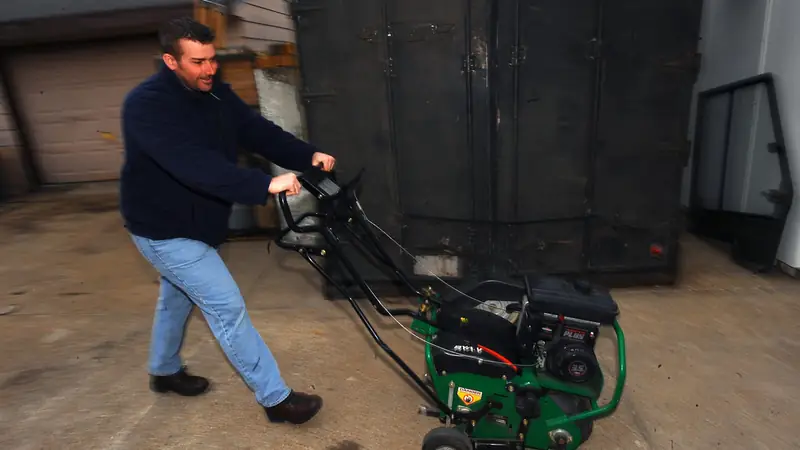
- Larger areas: a vertical mower (also sold as a power rake). Clemson suggests blade spacing of 1 to 2 inches for Kentucky bluegrass, red fescue, bermudagrass and zoysiagrass, and 2 to 3 inches for centipedegrass and St. Augustinegrass, with blades cutting through the thatch and at least ½ inch into the soil. Minnesota suggests setting it so the tines bring up a little soil with the debris.
- Direction: Clemson says centipedegrass and St. Augustinegrass should be vertically mowed in one direction only — multiple passes can kill them — while zoysiagrass and Kentucky bluegrass can take several directions.
- Severe thatch: Minnesota notes you may need to core aerate before vertical mowing.
Clemson cautions that improper dethatching can devastate a lawn; hiring a reputable lawn care company is an option.
Afterwards
- Rake up and remove the loosened material (Clemson).
- Water thoroughly so exposed roots do not dry out (Clemson).
- Clemson suggests about 1 lb of actual nitrogen per 1,000 sq ft a week later, watered in — work out the product with the Fertilizer Calculator.
- On a cool-season lawn, early fall dethatching is a good moment to overseed.
Preventing thatch
- Don’t overdo nitrogen. Minnesota and Clemson both name excessive fertilizer — especially in spring — as a cause. Minnesota prefers fall feeding because growth is less lush.
- Water deeply, not lightly and often (Maryland) — see how often to water.
- Core aerate. Minnesota says compacted, poorly drained soils build thatch faster; core aeration with hollow tines helps soil microbes break it down. See when to aerate.
- Mow regularly and leave the clippings. Minnesota: if you remove no more than a third of the leaf at each mowing, clippings decompose quickly and do not add to thatch. See how high to mow.
- Go easy on pesticides, which can reduce the earthworms and microbes that decompose thatch (Minnesota, Maryland), and keep the pH in range (Clemson).
Sources
- University of Minnesota Extension — How to Control Thatch in Your Lawn — Measuring thatch, causes, prevention through fertilizing, aerating and mowing, and vertical mowing.
- Clemson Cooperative Extension HGIC 2360 — Controlling Thatch in Lawns — Which grasses build thatch, when to dethatch cool- and warm-season lawns, and vertical mower settings.
- University of Maryland Extension — Maintaining an Established Lawn — Aeration, overseeding cool-season lawns step by step, fertilizer timing and thatch.
Sources were checked when this guide was published. Where published guidance differs, this guide says so; for structural work, follow your local specification.
Worked examples are generated by the same tested calculation engine as our calculators. See our editorial policy and methodology.