On this page (8 sections)
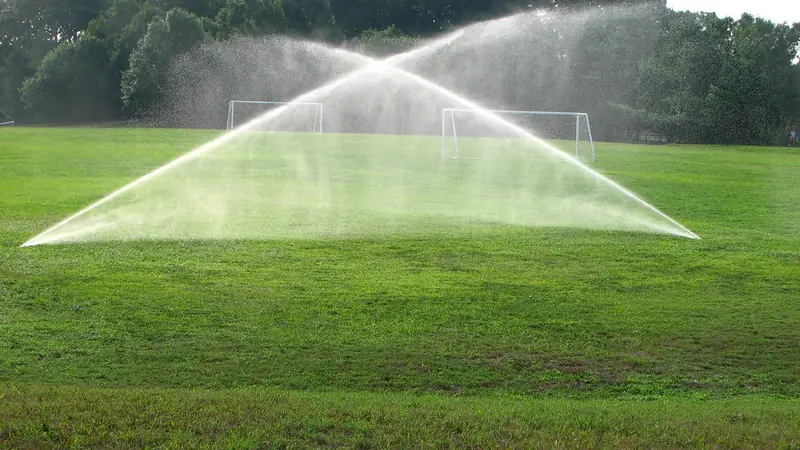
Most lawns are watered by the clock — a few minutes every evening — rather than by need. Clemson Extension recommends the opposite: wait until the lawn tells you it needs water, then water deeply enough to reach the roots, and let it dry out between waterings. The result is deeper roots, a more drought-tolerant lawn and a smaller water bill.
When to water: four signs
- Color: a lawn short of water takes on a bluish-gray cast.
- Footprints: walk across the lawn late in the day. If your footprints stay visible, the blades lack the water to spring back.
- Leaves: blades wilt, roll or fold.
- Screwdriver test: if a screwdriver is hard to push into the soil, the soil is very dry. Use it to confirm the visual signs.
How much water to apply
Clemson’s guidance: apply about ½ inch of water on coarse, sandy soil and 1 inch on heavy or fine-textured soil. That moistens the soil to a depth of about 4 to 6 inches. If water starts to run off before you finish, apply about ½ inch at a time and let it soak in before continuing.
To see what that is in gallons for your lawn, use the Lawn Watering Calculator — 1 inch over 1,000 sq ft is about 623 US gallons.
How often
Once you have watered, wait for the stress signs to return before watering again. Clemson advises never watering the grass every day except while establishing a new lawn, because small daily amounts encourage shallow roots and a less drought-tolerant lawn. Stretch the interval between waterings as long as you can. And once you start watering in a dry spell, keep going — waking a dormant lawn and then stopping exhausts it.
Best time of day
Early morning, according to Clemson: less water evaporates, and the grass dries quickly, which reduces the chance of fungal disease.
Calibrate your sprinkler (the can test)
- Set out 5 to 10 straight-sided containers (tuna or coffee cans, 3 to 6 inches across) — in a line from a hose-end sprinkler to the edge of its pattern, or scattered through one zone of an in-ground system.
- Run the water for 15 minutes.
- Pour all the water into one can and measure the depth; divide by the number of cans for the average.
- Multiply by 4 to get the rate in inches per hour.
| Water to apply | 0.5 in/h | 1 in/h | 1.5 in/h | 2 in/h |
|---|---|---|---|---|
| 0.25 in | 30 min | 15 min | 10 min | 8 min |
| 0.5 in | 60 min | 30 min | 20 min | 15 min |
| 0.75 in | 90 min | 45 min | 30 min | 23 min |
| 1 in | 120 min | 60 min | 40 min | 30 min |
Calculated with the formula above; Clemson’s table gives the same values (for example, ¾ inch at 2 inches per hour ≈ 23 minutes).
Letting the lawn go dormant
You can choose not to water in a long dry spell. Clemson notes that warm-season grasses such as centipede, bermuda, St. Augustine and zoysia generally survive dormancy and recover, and a well-established tall fescue lawn can usually go dormant without serious damage — but a newly established lawn with a limited root system may be badly injured or killed.
Ways to use less water
- Water only the areas that show stress — high spots, sandy patches and strips beside pavement dry first.
- Raise the mowing height in summer (see how high to mow).
- Aerate compacted clay so water soaks in instead of running off (see when to aerate).
- Fix leaky hoses and spigots; fit a rain shut-off to automatic systems.
Sources
- Clemson Cooperative Extension HGIC 1207 — Watering Lawns — Signs of drought stress, how much water to apply, morning watering, sprinkler calibration and run-time table (South Carolina).
Sources were checked when this guide was published. Where published guidance differs, this guide says so; for structural work, follow your local specification.
Worked examples are generated by the same tested calculation engine as our calculators. See our editorial policy and methodology.