How to use the gravel calculator
- Pick your units and shape. Choose imperial (feet and inches) or metric (metres and centimetres), then the shape that matches your area. Each measurement has its own unit menu, so you can mix feet and inches deliberately — the calculator converts everything before doing any maths.
- Enter the measurements and depth. Measure the finished surface, not the hole. Tap a depth chip for a typical starting point, then adjust it to your specification.
- Choose the material. This sets the density used for the weight estimate. If your supplier quotes a density, tick “Use my supplier’s density” and enter it.
- Add buying options (optional). Choose how orders are rounded, add a bag size, and enter your own prices for a cost estimate.
- Save or share. Download a PDF, print a summary, or copy a link that reopens the calculator with your numbers.
How much gravel do I need? Common sizes
Quick answers for typical US yard, bed and path sizes. For any other size, shape or depth — or to add an allowance, weights, bags and costs — use the calculator above.
| Area | 2 in deep | 3 in deep | 4 in deep |
|---|---|---|---|
| 10 × 10 ft 100 sq ft | 0.62 yd³ ≈0.83 t | 0.93 yd³ ≈1.25 t | 1.23 yd³ ≈1.66 t |
| 12 × 12 ft 144 sq ft | 0.89 yd³ ≈1.2 t | 1.33 yd³ ≈1.8 t | 1.78 yd³ ≈2.4 t |
| 10 × 20 ft 200 sq ft | 1.23 yd³ ≈1.66 t | 1.85 yd³ ≈2.5 t | 2.47 yd³ ≈3.33 t |
| 16 × 16 ft 256 sq ft | 1.58 yd³ ≈2.13 t | 2.37 yd³ ≈3.2 t | 3.16 yd³ ≈4.26 t |
| 20 × 20 ft 400 sq ft | 2.47 yd³ ≈3.33 t | 3.7 yd³ ≈4.99 t | 4.94 yd³ ≈6.66 t |
| 12 × 24 ft 288 sq ft | 1.78 yd³ ≈2.4 t | 2.67 yd³ ≈3.6 t | 3.56 yd³ ≈4.79 t |
| 20 × 40 ft 800 sq ft | 4.94 yd³ ≈6.66 t | 7.41 yd³ ≈9.99 t | 9.88 yd³ ≈13.32 t |
| 25 × 50 ft 1,250 sq ft | 7.72 yd³ ≈10.4 t | 11.57 yd³ ≈15.61 t | 15.43 yd³ ≈20.81 t |
Exact volume for a level area, before any extra allowance; order a little more for spillage and settling. “t” = US tons at YardCalio’s typical loose density for gravel (general, loose) (1.35 US tons per cubic yard). Real weights vary — your supplier’s figure takes priority.
The gravel formula
Every gravel estimate is three steps: area, volume, then weight.
Volume = Area × Depth (all in the same unit)
Cubic yards = Cubic feet ÷ 27
Adjusted volume = Volume × (1 + Extra % ÷ 100)
Weight = Volume × Density
The most common error is mixing units — multiplying feet by inches. Convert the depth first: 3 inches is 3 ÷ 12 = 0.25 ft; 7.5 cm is 0.075 m. The calculator does this automatically for every field.
Worked example
A 40 ft × 10 ft driveway topped with 4 in of crushed stone, plus 5% extra.
- Area = 40 × 10 = 400 ft²
- Depth = 4 ÷ 12 = 0.3333 ft, so volume = 400 × 0.3333 = 133.3 ft³
- 133.3 ÷ 27 = 4.938 yd³
- With 5% extra: 4.938 × 1.05 = 5.185 yd³ → order 5.25 yd³ (rounded up to the nearest ¼ yard)
- At a typical 100 lb/ft³, that is about 6.99 US tons (range 6.34–7.65 tons).
Metric: a 12 m × 3 m driveway with 10 cm of crushed stone, plus 5%.
- Area = 12 × 3 = 36 m²; volume = 36 × 0.10 = 3.6 m³
- With 5% extra: 3.78 m³ → order 3.8 m³
- At a typical 1.6 t/m³: about 6.05 tonnes (range 5.48–6.62 t).
How deep should gravel be?
Depth depends on what the surface has to carry and what is underneath it. These are typical planning ranges used in landscaping practice; a driveway in particular should follow a specification suited to your soil, climate and vehicles.
| Use | Typical depth (inches) | Typical depth (mm) |
|---|---|---|
| Decorative beds | 2–3 in | 50–75 mm |
| Garden path (top layer) | 2–3 in | 50–75 mm |
| Gravel patio / seating area | 3–4 in | 75–100 mm |
| Driveway top layer | 2–4 in | 50–100 mm |
| Driveway sub-base (compacted) | 4–8 in | 100–200 mm |
For driveways, the figures above are usually separate layers: a compacted sub-base (often crusher run or Type 1) and a thinner decorative or surface layer. Calculate each layer separately — they are different materials with different densities.
Crushed stone or pea gravel?
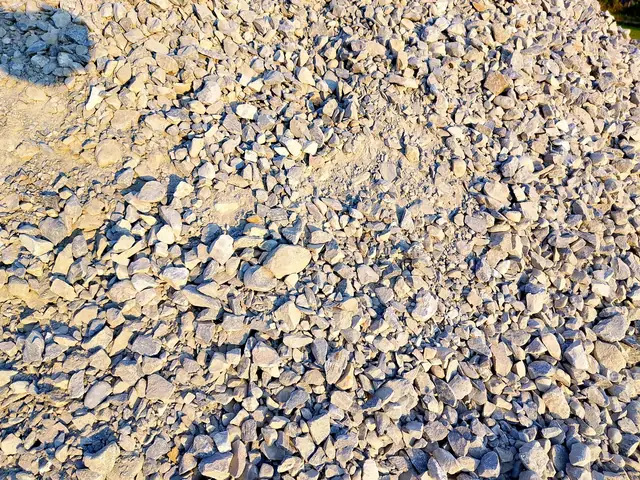
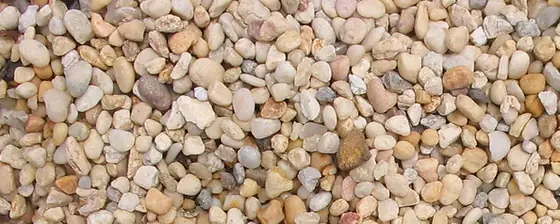
The two look similar in a bag but behave differently on the ground. Choose the matching material in the calculator — they have different typical densities.
Gravel weight: tons per cubic yard
Gravel is often sold by weight, so you need its bulk density — the weight of a loose volume including the air gaps between stones. It varies with rock type, stone size, moisture and how much fine material is mixed in.
| Material | Typical range (lb/ft³) | US tons per yd³ | Tonnes per m³ |
|---|---|---|---|
| Gravel (general, loose) | 91–109 | 1.22–1.47 | 1.45–1.75 |
| Crushed stone (e.g. #57 / 20 mm clean) | 91–109 | 1.22–1.47 | 1.45–1.75 |
| Pea gravel | 91–106 | 1.22–1.43 | 1.45–1.7 |
| River rock / decorative cobbles | 84–106 | 1.14–1.43 | 1.35–1.7 |
| Crusher run / Type 1 sub-base (loose) | 106–131 | 1.43–1.77 | 1.7–2.1 |
Typical values for loose, as-delivered material. They are planning approximations, not specifications — your supplier’s figure for their product always takes priority.
Because of this range, the calculator shows weight as a typical figure and a range. For example, one cubic yard of general gravel weighs roughly 1.22–1.47 US tons on these figures.
Common mistakes to avoid
- Multiplying feet by inches. 20 ft × 10 ft × 3 in is not 600 cubic anything. Convert depth to feet (0.25 ft) first: 50 ft³ = 1.85 yd³.
- Measuring the excavation, not the finished layer. Calculate each layer at its finished depth.
- Forgetting compaction. Crusher run and sub-base materials compact under a roller or plate, so you need more loose material than the finished depth suggests. Ask your supplier how much extra to allow for their product.
- Confusing tons. A US (short) ton is 2,000 lb; a metric tonne is 1,000 kg (about 2,205 lb); a UK long ton is 2,240 lb. The calculator labels each one explicitly.
- Rounding down. Running short mid-job usually costs more than a little spare. Round up — the calculator never rounds down.
Frequently asked questions
How many square feet does a cubic yard of gravel cover?
At 2 inches deep, one cubic yard covers 162 ft²; at 3 inches, 108 ft²; at 4 inches, 81 ft². The rule is: coverage = 324 ÷ depth in inches (because 1 yd³ = 27 ft³ = 324 ft² × 1 in).
How many cubic metres does a tonne of gravel make?
It depends on density. At a typical 1.6 t/m³, one tonne is about 0.63 m³. At 1.45 t/m³ it is about 0.69 m³, and at 1.75 t/m³ about 0.57 m³.
How much extra gravel should I order?
Many people add 5–10% for spillage, uneven sub-grade and settling. Add more for compactable materials such as crusher run — your supplier can tell you how much their product compacts.
Can I calculate an L-shaped or irregular area?
Yes — split it into rectangles, triangles and circles, calculate each, then add them together. The Garden Material Planner does this for you and totals by material.
Does the calculator send my measurements anywhere?
No. Every calculation, and the PDF, is created in your browser. Nothing is uploaded.
Sources & methodology
Unit conversions use exact legal definitions. Material densities are typical planning values that vary in practice — see the calculation methodology for every constant, rounding rule and test.
- NIST Special Publication 811 — Guide for the Use of the International System of Units (SI) — Exact definitions used for inch, foot, yard and pound conversion factors.
- Weights and Measures Act 1985 (UK), Schedule 1 — UK legal definitions of the yard (0.9144 m) and pound (0.45359237 kg).