On this page (7 sections)
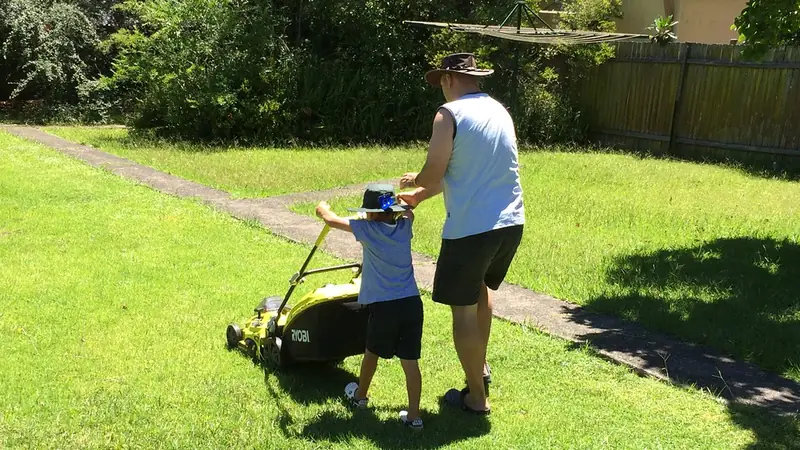
Mowing height is one of the easiest things to get right and one of the most common things to get wrong. Clemson Extension explains that proper mowing encourages a dense stand of grass, and a dense lawn crowds out weeds by competing for light and nutrients. Mow too short and the lawn thins, roots stop growing and weeds move in.
Recommended mowing heights
| Grass | Mowing height (in) |
|---|---|
| Tall fescue | 2–3 (winter) · 3–3½ (summer) |
| Fine fescue | 1½–2½ (winter) · 2½–3 (summer) |
| Ryegrass | 1–2½ (winter) |
| Common bermudagrass | 1–2 |
| Hybrid bermudagrass | ½–1½ |
| Carpetgrass | 1½–2 |
| Centipedegrass | 1½–2 |
| St. Augustinegrass | 2½–4 |
| Zoysiagrass | 1–2 |
From Clemson Extension HGIC 1205 (South Carolina conditions). Cool-season heights are given for winter and summer as in the source. Your local extension office can confirm heights for your region.
Clemson’s general rules: grasses that spread sideways can be mown shorter than upright bunch-type grasses, narrow-bladed grasses shorter than wide-bladed ones, and any grass under stress — heat, drought or shade — should be mown at the higher end of its range. In shade, a taller cut leaves more leaf to catch the light.
The one-third rule
Remove no more than one-third of the grass height at any one mowing. To keep a centipede lawn at 2 inches, mow when it reaches about 3 inches. Cutting more than a third at once can stop root growth and leaves the lawn needing more water in dry summers. If the lawn has grown too tall, raise the mower and bring the height down gradually over several mowings.
Rotary or reel mower?
- Rotary mowers are the most common: affordable, maneuverable and simple to maintain. Clemson notes most cannot give a quality cut below about 1 inch (2 inches on zoysiagrass). Mulching models chop clippings small so they drop into the lawn.
- Reel mowers cut with a scissor action for a very clean cut at 2 inches or less, and Clemson recommends them for bermudagrass and zoysiagrass. They need a smooth surface and professional sharpening.
Keep the blade sharp
A dull blade tears leaves instead of cutting them, leaving brown tips and a brownish cast over the lawn. Torn grass heals slowly and is more open to weeds, disease and insects.
Leave the clippings
Clemson Extension estimates that grass clippings contain about 4% nitrogen, ½–1% phosphorus and 2–3% potassium — roughly a 4-1-3 fertilizer — which returns to the soil when you leave them on the lawn. Following the one-third rule keeps clippings small enough to disappear quickly.
Mowing and the rest of lawn care
Mowing height interacts with everything else: a higher cut shades the soil and reduces water stress (see how often to water); feeding drives how fast the grass grows and how often you mow (see how to calculate fertilizer); and the grass species sets the height range (see cool-season vs warm-season grass).
Sources
- Clemson Cooperative Extension HGIC 1205 — Mowing Lawns — Recommended mowing heights by grass, the one-third rule, mower types and grass clippings (South Carolina).
- Clemson Cooperative Extension HGIC 1214 — Selecting a Lawn Grass — Characteristics of southern lawn grasses: establishment methods, maintenance, mowing height and tolerances.
Sources were checked when this guide was published. Where published guidance differs, this guide says so; for structural work, follow your local specification.
Worked examples are generated by the same tested calculation engine as our calculators. See our editorial policy and methodology.