On this page (7 sections)
Landscape fabric (weed barrier or geotextile) comes in rolls of a fixed width. Covering a bed wider than one roll means laying strips side by side with an overlap, so the fabric you use is always more than the area you cover. Here is how to count it properly.
Step 1: count the strips
The first strip covers a full roll width. Every strip after that overlaps its neighbour, so it adds only the roll width minus the overlap. The overlap comes from the product instructions.
Step 2: total length and rolls
Lay the strips along the longer side of the bed to reduce joints. Total fabric length = strips × bed length. Then work out how many whole strips each roll gives — a roll that is 50 ft long gives one 40 ft strip and a 10 ft offcut, not 1.25 strips.
Worked example
A 40 × 10 ft gravel path base with 3 ft × 50 ft rolls and a 6 in overlap.
- Strips = 1 + (10 − 3) ÷ 2.5 = 3.8 → 4
- Fabric length = 4 × 40 = 160 ft — 480 sq ft of fabric for 400 sq ft of path
- Each 50 ft roll gives 1 strip → 4 rolls
With 6 ft wide rolls instead: 2 strips, 2 rolls — wider rolls mean fewer overlaps.
Why not just divide the area?
Area ÷ roll area ignores both the overlaps and the offcuts, so it usually tells you to buy too little. In the example, 400 sq ft ÷ 150 sq ft per roll suggests 3 rolls, but the layout actually needs 4.
How many landscape staples?
Staples go along the outer edges and down every overlap seam. The spacing comes from the product instructions; the count is:
For the 40 × 10 ft example there are 3 seams of 40 ft and a 100 ft perimeter, so 100 + 120 = 220 ft of edge to pin. If the instructions said every 3 ft, that would be 74 staples — the 3 ft spacing here is only an example.
Laying tips
- Pin overlaps and edges with landscape staples, and tuck the edges under edging or into a shallow trench.
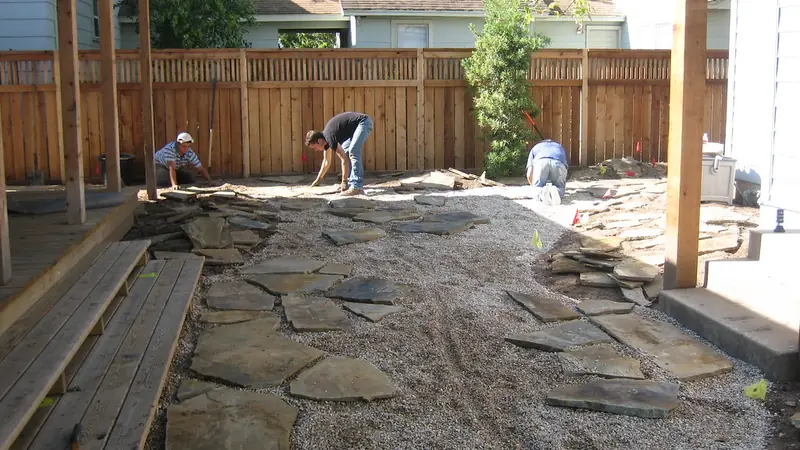
- Under gravel, fabric keeps stone and soil apart; see how to plan a gravel garden path.
- Around curves, lay straight strips and trim — order a little extra for tucking in.
The Landscape Fabric Calculator works out strips and rolls for any bed and roll size.
Sources
- NIST Special Publication 811 — Guide for the Use of the International System of Units (SI) — Exact definitions of the inch, foot, yard, acre, pound, US gallon and the cubic yard used in every calculation in this guide.
Sources were checked when this guide was published. Where published guidance differs, this guide says so; for structural work, follow your local specification.
Worked examples are generated by the same tested calculation engine as our calculators. See our editorial policy and methodology.