How to use the pea gravel calculator
- Choose the shape of your path, patio or bed and enter its measurements.
- Pick a typical depth for the use (walkway, patio, decorative cover, drainage), then fine-tune it.
- Open Buying in bags? and choose a bag size — by volume (cu ft or litres) or by weight (lb or kg). Weight-rated bags are converted to volume using the material’s density.
- Add prices if you want a cost estimate, then download the PDF or print it for the store.
How much pea gravel do I need? Common sizes
Quick answers for typical US yard, bed and path sizes. For any other size, shape or depth — or to add an allowance, weights, bags and costs — use the calculator above.
| Area | 2 in deep | 3 in deep |
|---|---|---|
| 10 × 10 ft 100 sq ft | 0.62 yd³ ≈0.81 t | 0.93 yd³ ≈1.21 t |
| 12 × 12 ft 144 sq ft | 0.89 yd³ ≈1.16 t | 1.33 yd³ ≈1.74 t |
| 10 × 20 ft 200 sq ft | 1.23 yd³ ≈1.61 t | 1.85 yd³ ≈2.42 t |
| 16 × 16 ft 256 sq ft | 1.58 yd³ ≈2.06 t | 2.37 yd³ ≈3.1 t |
| 20 × 20 ft 400 sq ft | 2.47 yd³ ≈3.23 t | 3.7 yd³ ≈4.84 t |
| 12 × 24 ft 288 sq ft | 1.78 yd³ ≈2.32 t | 2.67 yd³ ≈3.48 t |
| 20 × 40 ft 800 sq ft | 4.94 yd³ ≈6.45 t | 7.41 yd³ ≈9.68 t |
| 25 × 50 ft 1,250 sq ft | 7.72 yd³ ≈10.08 t | 11.57 yd³ ≈15.12 t |
Exact volume for a level area, before any extra allowance; order a little more for spillage and settling. “t” = US tons at YardCalio’s typical loose density for pea gravel (1.31 US tons per cubic yard). Real weights vary — your supplier’s figure takes priority.
Pea gravel coverage
Coverage is simply volume divided by depth. These figures are exact for a level surface at the depth shown — useful when comparing bulk delivery with bags.
Imperial coverage
| Depth | 1 cubic yard covers | 0.5 cu ft bag covers | 2 cu ft bag covers |
|---|---|---|---|
| 1 in | 324 ft² | 6 ft² | 24 ft² |
| 2 in | 162 ft² | 3 ft² | 12 ft² |
| 3 in | 108 ft² | 2 ft² | 8 ft² |
| 4 in | 81 ft² | 1.5 ft² | 6 ft² |
Metric coverage
| Depth | 1 m³ covers | 50 L bag covers | 25 kg bag covers* |
|---|---|---|---|
| 25 mm | 40 m² | 2 m² | 0.65 m² |
| 50 mm | 20 m² | 1 m² | 0.32 m² |
| 75 mm | 13.3 m² | 0.67 m² | 0.22 m² |
| 100 mm | 10 m² | 0.5 m² | 0.16 m² |
Coverage = volume ÷ depth, exact for a level surface. *Weight-rated bags are converted at a typical pea gravel density of 1,550 kg/m³, so actual coverage per 25 kg bag varies with the product.
Pea gravel or crushed stone?
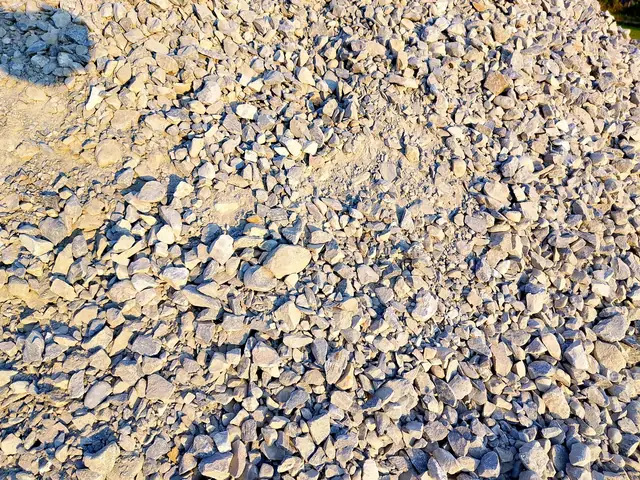
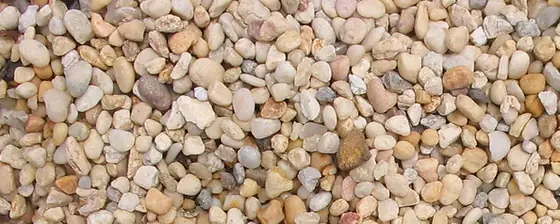
Pea gravel is rounded and loose; crushed stone is angular and compacts. Many paths use both: a compacted crushed-stone base with a thin pea gravel top layer.
How deep should pea gravel be?
Pea gravel’s rounded stones move under foot, so depth is a balance: too thin and the base shows through; too thick and walking feels like wading through it. Typical planning ranges:
| Use | Typical depth (inches) | Typical depth (mm) |
|---|---|---|
| Decorative cover / mulch alternative | 2–3 in | 50–75 mm |
| Walkway or garden path | 2–3 in | 50–75 mm |
| Pea gravel patio | 3–4 in | 75–100 mm |
| Drainage backfill (trench/pipe) | 4–12 in | 100–300 mm |
For walkways and patios, an edging restraint and a compacted, angular sub-base underneath help stop the gravel migrating. Play areas are different: protective surfacing depth depends on fall height, so follow the U.S. Consumer Product Safety Commission’s Public Playground Safety Handbook or your local standard rather than decorative depths.
Worked examples
A 30 ft × 3 ft garden walkway at 2 in deep, 5% extra, in 0.5 cu ft bags.
- Area = 30 × 3 = 90 ft²; volume = 90 × (2 ÷ 12) = 15 ft³ = 0.556 yd³
- With 5% extra: 15.75 ft³ (0.583 yd³) → bulk order 0.75 yd³
- In 0.5 cu ft bags: 15.75 ÷ 0.5 = 31.5 → 32 bags
- Typical weight: about 1,524 lb (0.762 US tons).
Metric: a round bed 3 m across at 5 cm deep, 5% extra, in 25 kg bags.
- Area = π × 1.5² = 7.069 m²; volume = 7.069 × 0.05 = 0.353 m³
- With 5% extra: 0.371 m³ ≈ 575 kg at 1,550 kg/m³
- 25 kg bags: 575 ÷ 25 = 23.01 → 24 bags. Because bag weight depends on density, check the bag label for its stated coverage too.
Bulk or bags?
Bags are convenient for small areas and access through a house; bulk loads are usually better value once you need more than a fraction of a cubic yard (or a cubic metre), but have delivery charges and need somewhere to tip. Enter both a bag price and a bulk price in turn and compare the totals — the calculator only uses the prices you type in.
Common pea gravel mistakes
- Laying it too deep on a path. Deep loose gravel is hard to walk on and push a wheelbarrow through.
- No edging. Without an edge restraint, pea gravel migrates into lawns and beds.
- Assuming bag weight equals coverage. Two 50 lb bags from different quarries can cover different areas. Use the density setting if the bag lists one.
- Using it on steep slopes. Rounded stones roll downhill; angular gravel or a stabilising grid is usually better there.
Frequently asked questions
How many bags of pea gravel do I need per square foot?
At 2 inches deep a 0.5 cu ft bag covers 3 ft², so you need one bag for every 3 ft². At 3 inches it covers 2 ft². The calculator works this out for any size of bag.
How much does a cubic yard of pea gravel weigh?
Using the typical range in this calculator (2,444–2,865 lb per cubic yard), about 1.22–1.43 US tons. Ask your supplier for their figure.
Is pea gravel the same as river rock?
Both are rounded, water-worn stones. “Pea gravel” usually means small stones of about 3/8 inch (around 10 mm); river rock is larger. Larger stones leave bigger gaps, which changes the density — choose the matching material in the calculator.
What depth of pea gravel do I need under a playset?
Use the CPSC Public Playground Safety Handbook (or your national standard), which relates loose-fill depth to fall height. Decorative depths are not suitable for fall protection.
Sources & methodology
Unit conversions use exact legal definitions. Material densities are typical planning values that vary in practice — see the calculation methodology for every constant, rounding rule and test.
- NIST Special Publication 811 — Guide for the Use of the International System of Units (SI) — Exact definitions used for inch, foot, yard and pound conversion factors.
- Weights and Measures Act 1985 (UK), Schedule 1 — UK legal definitions of the yard (0.9144 m) and pound (0.45359237 kg).
- U.S. Consumer Product Safety Commission — Public Playground Safety Handbook — Guidance on loose-fill protective surfacing depths for play areas.