On this page (7 sections)
Clemson Extension calls mulching one of the most important ways to keep landscape plants healthy. Done right, it holds water in the soil, smothers weeds, evens out soil temperature, stops soil splashing onto leaves and — for organic mulches — improves the soil as it breaks down. Done wrong, it can starve roots of air or rot the base of shrubs. Here is how to do it right.
When to mulch
- New plantings: right after you plant (Clemson).
- Established beds: early spring, as plants begin to grow and before weed seeds germinate (Clemson).
- Weed first. Clemson advises removing weeds before spreading any mulch.
How deep
The right depth depends on the texture of the material — finer mulches pack down and keep air out.
| Mulch | Depth | Why |
|---|---|---|
| Fine wood and bark mulches | 2–3 in, no more | Excess can suffocate roots — yellow leaves, poor growth |
| Coarse mulches (pine bark nuggets) | up to 4 in | Air moves through easily |
| Grass clippings, shredded leaves | 2 in at most | They mat together and block water and air |
| Small gravel or pebbles | about 1 in | Enough for weed control |
From Clemson HGIC 1604. UF/IFAS recommends 2–3 inches around established trees, shrubs and bedding plants, only 1 inch around seedlings and small vegetables or herbs, and no more than 3 inches, which can divert water away from roots.
Work out how much to buy with the Mulch Calculator, or see how much mulch do I need. Both UF and Clemson use the same rule: one cubic yard covers 324 sq ft one inch deep, or 108 sq ft three inches deep.
Keep it off stems and walls
- 2 to 3 inches from the stems of woody plants — wet mulch against bark causes decay and invites rodents in winter (Clemson).
- 6 to 12 inches from building walls — termite treatments are in the soil next to foundations, and mulch can give termites a bridge across them (Clemson).
- Around trees, never pile mulch against the trunk — see how to mulch around trees.
Topping up
Organic mulches settle and decompose. Clemson notes grass clippings and leaves need frequent replenishing, while pine needles and bark usually last two to four years. UF/IFAS’s rule: when the layer falls below 2 inches, add a thin new layer on top — don’t strip the old mulch off, which can damage surface roots. As plants fill in, less mulch is needed. Rake old mulch lightly if it has matted.
Problems to watch for
- Sour mulch. Mulch stored in big piles without air can turn toxic. Clemson says it smells of vinegar, ammonia, sulfur or silage instead of fresh wood or earth, and can quickly damage bedding plants and low shrubs. Turning the pile and letting it air out for a few days fixes it.
- Matted mulch. Thick layers of dry mulch can grow a water-repelling fungal mat. Clemson advises watering new mulch and breaking up matted layers with a rake.
- Slime molds. Bright yellow or orange blobs in warm, damp weather are unsightly but harmless — scoop them up (Clemson).
- Black plastic. Clemson does not usually recommend it under mulch: it blocks water and air, and roots need both.
Which mulch?
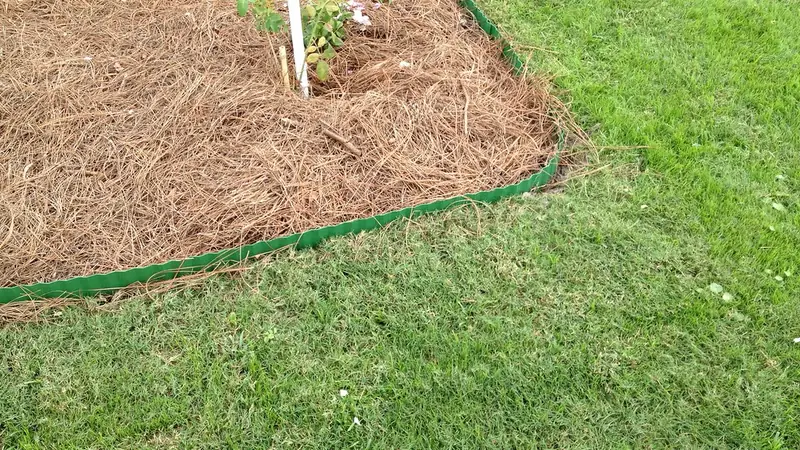
For the pros and cons of bark, pine straw, leaves, wood chips and stone, see types of mulch and rock vs wood mulch. Edging keeps mulch in the bed — plan it with the Landscape Edging Calculator.
Sources
- Clemson Cooperative Extension HGIC 1604 — Mulch — Benefits of mulch, organic and inorganic materials, depths by texture, when to mulch, spacing from stems and buildings, tree rings and sour mulch.
- UF/IFAS Gardening Solutions — Choosing and Installing Mulches — Mulch types and their drawbacks, recommended depths, coverage per cubic yard and when to replenish (Florida).
Sources were checked when this guide was published. Where published guidance differs, this guide says so; for structural work, follow your local specification.
Worked examples are generated by the same tested calculation engine as our calculators. See our editorial policy and methodology.