On this page (6 sections)
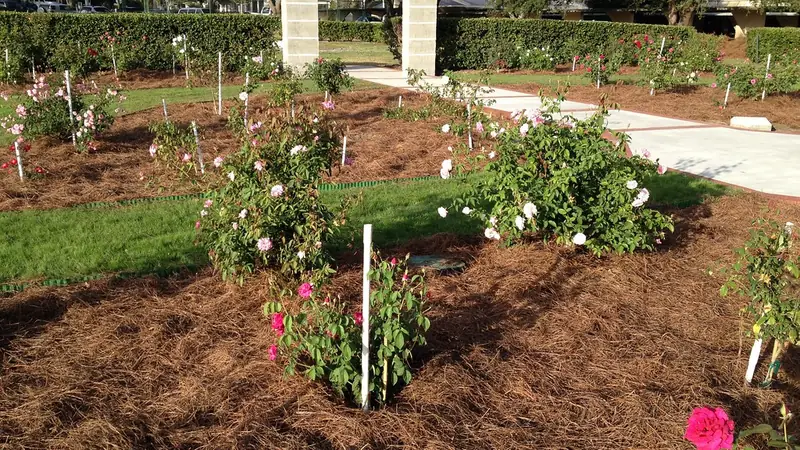
A ring of mulch is one of the best things you can give a tree. Clemson Extension notes that mulched plants grow more roots, that mulch removes competition from grass and weeds for water and nutrients, and that it helps protect trunks from mowers and trimmers. But the same mulch, piled up against the trunk, does harm.
First: no volcanoes
“Volcano mulching” — a cone of mulch heaped up against the trunk — is common and damaging. Clemson warns that mulch should never touch the trunk, because piling it against the bark damages it, and advises keeping mulch off the stem to reduce the chance of rot. Purdue’s urban forestry specialist recommends leaving a gap of about 2 inches between trunk and mulch: “Remember, no volcano mulching.”
How wide should the ring be?
- Newly planted trees: a circle of mulch 3 to 4 feet in diameter (Clemson). Purdue suggests at least a 3-foot radius from the trunk. Widen it as the tree grows.
- Established trees in lawns: about 2 feet of ring diameter for each inch of trunk diameter (Clemson). Ideally extend it 6 to 12 inches beyond the drip line — Clemson notes roots can spread two to three times as wide as the crown, so mulch as large an area as you can.
How deep?
Clemson recommends 2 to 4 inches of organic mulch after planting a tree, and in its photo guide uses 3 inches of double-ground hardwood bark. Purdue suggests 2 to 3 inches. Fine-textured mulch should not go deeper than 2 to 3 inches; coarse nuggets can go to about 4 (Clemson HGIC 1604).
How much mulch for a tree ring
Cubic feet = π × (Diameter ÷ 2)² × Depth (in) ÷ 12
| Trunk diameter | Ring diameter | Mulch | Order |
|---|---|---|---|
| 2 in | 4 ft | 3.1 cu ft | 0.12 cu yd |
| 4 in | 8 ft | 12.6 cu ft | 0.47 cu yd |
| 6 in | 12 ft | 28.3 cu ft | 1.05 cu yd |
| 8 in | 16 ft | 50.3 cu ft | 1.86 cu yd |
Ring size from Clemson’s 2 ft per inch of trunk rule; volumes are exact for a flat circle. A new tree with a 4-ft ring 3 inches deep needs 3.1 cu ft — about 2 two-cubic-foot bags. For several trees, use the Mulch Calculator’s circle shape.
Step by step
- Remove grass and weeds inside the ring (an edging tool or spade makes a clean edge).
- Spread mulch to an even depth across the whole ring.
- Pull it back so it does not touch the trunk — a doughnut, not a volcano.
- Water well, especially for a new tree — see how to plant a tree.
- Top up as it settles, and enlarge the ring as the canopy spreads.
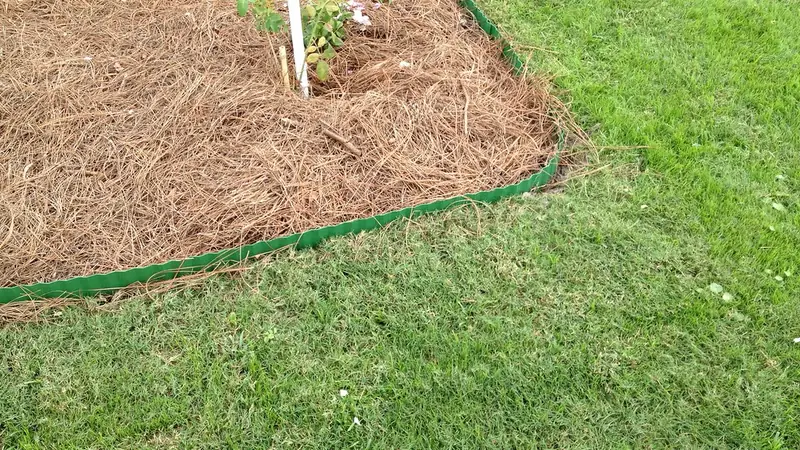
An edged ring keeps mulch in and mowers out — plan it with the Landscape Edging Calculator’s tree-ring option.
Sources
- Clemson Cooperative Extension HGIC 1604 — Mulch — Benefits of mulch, organic and inorganic materials, depths by texture, when to mulch, spacing from stems and buildings, tree rings and sour mulch.
- Clemson Cooperative Extension HGIC 1001 — Planting Trees Correctly — Planting depth, root ball preparation, backfill, water rings and mulch after planting.
- Purdue Extension — Fallen Leaves and Tree Maintenance in Autumn — Mulching leaves into turf (Purdue research) and autumn tree mulching.
Sources were checked when this guide was published. Where published guidance differs, this guide says so; for structural work, follow your local specification.
Worked examples are generated by the same tested calculation engine as our calculators. See our editorial policy and methodology.