On this page (8 sections)
A soil test tells you what your soil actually needs — lime or sulfur to correct pH, and how much phosphorus and potassium to add (or not). Without one you are guessing, and Maryland Extension warns that unneeded phosphorus can wash into waterways and feed algae. A basic test is inexpensive through your county Cooperative Extension office or a university lab. Here is how to take a good sample.
What you need
- A clean plastic bucket — Penn State advises avoiding metal buckets, which can contaminate the sample.
- A soil probe, or a trowel or spade.
- Plastic bags or the lab’s sample bags, and a marker.
- The lab’s submission form — check its instructions, since labs differ.
1. Divide the yard into areas
Illinois Extension says each sample should come from a uniform area: don’t mix lawn soil with vegetable garden soil, because they are managed differently. Sample a problem area separately from a healthy one if you want to compare. Avoid unusual spots such as compost piles, wet spots or where a burn pile stood.
2. Sample at the right depth
| Area | Depth | Source |
|---|---|---|
| Lawns | 2–4 in | Clemson |
| Lawns | 4–6 in | Illinois |
| Gardens and beds | 6 in | Clemson |
| Tilled garden beds | 6–10 in | Illinois |
| Gardens and fields | at least 6 in | Minnesota |
Depths differ between labs — use your lab’s instructions. Whatever depth you choose, use it for every core.
Illinois stresses keeping the depth uniform: if one subsample is 6 inches deep, make them all 6 inches. Remove grass, mulch and thatch from the top of each core.
3. Collect and mix subsamples
- Walk the area in a zig-zag and take 8 to 10 subsamples (Clemson) — Illinois says ten are adequate for home lawns and gardens up to 10,000 sq ft; Minnesota suggests 4 to 6 for a garden.
- With a probe, push it in to the depth and pull up a core. With a trowel, Illinois’s method: cut out a wedge, then slice a ½-inch-thick strip down one side of the hole and trim it to about an inch wide.
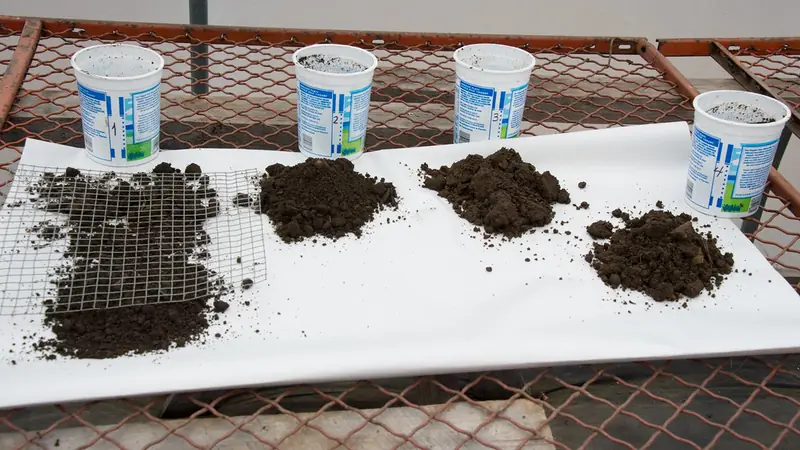
- Put every subsample in the bucket and mix thoroughly.
4. Bag, label and send
Put about 2 cups of the mixed soil in a bag (Clemson and Minnesota; Illinois says one to two cups), label it with your name, the date and the area — “front lawn” or “vegetable garden” — and send it with the form. If you live in an older urban area, Illinois suggests asking about a lead test as an option.
When and how often
- Minnesota recommends testing every four years, or whenever plants show nutrient problems.
- Test in the same season each time so results are comparable (Minnesota).
- Clemson suggests sampling in fall for next year’s garden, which leaves time to apply lime well before planting.
- Test before a new lawn or bed, and before adding compost or manure in quantity.
Reading the report
- pH — Maryland notes vegetables, grasses and most ornamentals grow best around 5.5 to 7.0; azaleas, rhododendrons and blueberries prefer 4.5 to 5.5. See how to change soil pH.
- Buffer pH — Maryland explains this measures “stored” acidity and is what the lab uses to set the lime rate.
- Phosphorus and potassium — Maryland advises not adding phosphorus when levels are medium, optimum or high.
- Organic matter — Minnesota suggests adding organic matter if it is below about 5–6%.
- Recommendations — usually in pounds per 1,000 sq ft. Turn a nutrient recommendation into pounds of product with the Fertilizer Calculator.
Sources
- Clemson Cooperative Extension HGIC — How to Take a Soil Sample — Number of samples, depth for gardens and lawns, and how much soil to submit.
- Illinois Extension — Collecting Soil Samples — Uniform areas, sampling depths for lawns and gardens, number of subsamples, tools and lead testing.
- University of Minnesota Extension — Step-by-Step Lawn & Garden Soil Sampling Guide — How many subsamples, sampling depth, how much soil to send, how often to test and reading results.
- Penn State Extension — How to Take a Soil Sample — Tools for sampling, including using a clean plastic bucket rather than a metal one.
- University of Maryland Extension — Understanding Your Soil Test Report — Soil pH and buffer pH, lime types and limits per application, sulfur and iron sulfate for lowering pH.
Sources were checked when this guide was published. Where published guidance differs, this guide says so; for structural work, follow your local specification.
Worked examples are generated by the same tested calculation engine as our calculators. See our editorial policy and methodology.