On this page (5 sections)
Soil pH controls how available nutrients are to plants. Clemson Extension explains that in very acidic soil, aluminum and manganese can become toxic while calcium, phosphorus and magnesium become less available; above about pH 6.5, phosphorus and most micronutrients become less available. Getting pH into the right range often fixes “deficiencies” that fertilizer cannot. But the first rule, says Clemson, is to always test the soil before adjusting pH — see how to test your soil.
What pH do plants want?
| Plants | Target pH | Source |
|---|---|---|
| Vegetables, grasses, most ornamentals | 5.5–7.0 | Maryland |
| Vegetables, grasses, most ornamentals | 5.8–6.5 | Clemson |
| Azaleas, rhododendrons, blueberries, conifers | 4.5–5.5 | Maryland |
| Azaleas, rhododendrons, blueberries, conifers | 5.0–5.5 | Clemson |
Soils differ in how much they resist change. Clemson notes sandy soils change more easily than clay soils; clay and high-organic-matter soils have more “buffering capacity” and need more material for the same change. Maryland explains that the buffer pH on your report measures this stored acidity — it is what the lab uses to set your lime rate.
Raising pH: lime
- Types. Calcitic (“garden”) lime supplies calcium; dolomitic lime adds magnesium and is recommended when the test shows magnesium is also low (Maryland, NC State).
- Form. Powdered, granular or pelletized; the finer the particles, the faster it works. Pelletized and coarse lime spread more easily on lawns. Maryland does not recommend hydrated lime because it can burn plants if misused.
- How much. Follow your soil test. Labs usually report pounds of ground limestone per 1,000 sq ft; if yours gives pounds per acre, NC State says divide by 43.5.
- Limits. Maryland: don’t spread more than 50 lb per 1,000 sq ft on a lawn in one application — split larger amounts, about six months apart. Up to 70 lb can go on at once if it is worked into the soil.
- Timing. Clemson suggests fall or winter, ideally two to three months before planting, so the lime has time to react.
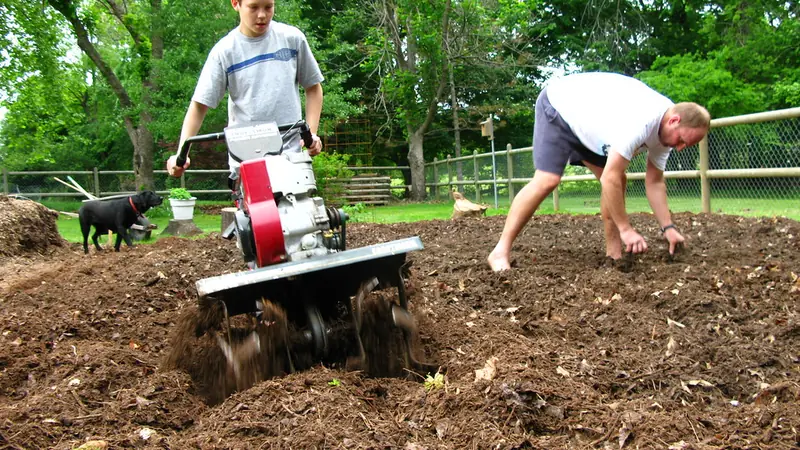
- Placement. Lime moves little in the soil. NC State says it can be worked 4 to 8 inches into lawns and gardens with a tiller, spade or rake; on established lawns, leave it on the surface or apply it before core aeration.
Example: a lab recommends 85 lb of lime per 1,000 sq ft for a 3,000 sq ft lawn.
- Total = 85 × 3 = 255 lb
- Over the 50 lb limit per application, so apply 50 lb per 1,000 sq ft now (150 lb) and the remaining 35 lb per 1,000 sq ft (105 lb) about six months later — the split Maryland Extension describes.
Lowering pH: sulfur
To make soil more acidic — usually for blueberries, azaleas and rhododendrons — the common materials are elemental sulfur and iron or aluminum sulfate. Clemson explains soil bacteria convert sulfur to sulfuric acid, which is slow and depends on soil temperature, taking several months. Aluminum sulfate acts immediately, but Maryland advises avoiding it because aluminum can become toxic to plants as pH falls.
Clemson’s table for elemental sulfur on loamy soil, converted from its pounds per 10 sq ft to pounds per 1,000 sq ft:
| Present pH | to 6.5 | to 6.0 | to 5.5 | to 5.0 | to 4.5 |
|---|---|---|---|---|---|
| 8.0 | 30 | 40 | 50 | 60 | 70 |
| 7.5 | 20 | 30 | 40 | 50 | 60 |
| 7.0 | 10 | 20 | 30 | 40 | 50 |
| 6.5 | — | 10 | 20 | 30 | 40 |
From Clemson HGIC 1650 (pounds per 10 sq ft × 100). Clemson: reduce the rate by one-third for sandy soils, increase it by one-half for clay soils, and do not repeat applications without retesting.
Clemson’s figures are for mixing into soil before planting. On established plants and lawns, use smaller amounts and retest — sulfur can injure plants if overused, and your lab’s recommendation always takes priority.
Other things that change pH
- Fertilizers containing ammonium or urea gradually acidify soil (Clemson).
- Pine needles, oak leaves and decomposing organic matter can slightly increase acidity (Clemson).
- Wood ash raises pH and can do so significantly in sandy soils; Clemson suggests a thin layer in winter, worked in in spring. Utah State, where soils are already alkaline (about pH 8), says never to add lime or wood ash.
Sources
- Clemson Cooperative Extension HGIC 1650 — Changing the pH of Your Soil — Target pH ranges, lime materials and timing, and sulfur and aluminum sulfate rate tables for loamy soil.
- University of Maryland Extension — Understanding Your Soil Test Report — Soil pH and buffer pH, lime types and limits per application, sulfur and iron sulfate for lowering pH.
- NC State Extension — Soil Acidity and Liming: Basic Information for Farmers and Gardeners — Calcitic and dolomitic lime, converting per-acre recommendations to per 1,000 sq ft, and incorporating lime in lawns and gardens.
Sources were checked when this guide was published. Where published guidance differs, this guide says so; for structural work, follow your local specification.
Worked examples are generated by the same tested calculation engine as our calculators. See our editorial policy and methodology.