On this page (6 sections)
“Put fabric down first” is standard advice in many garden centers. The honest answer is that it depends on what goes on top. Landscape fabric does a useful job under gravel — and often a counterproductive one under mulch in planted beds.
Under gravel: a separator
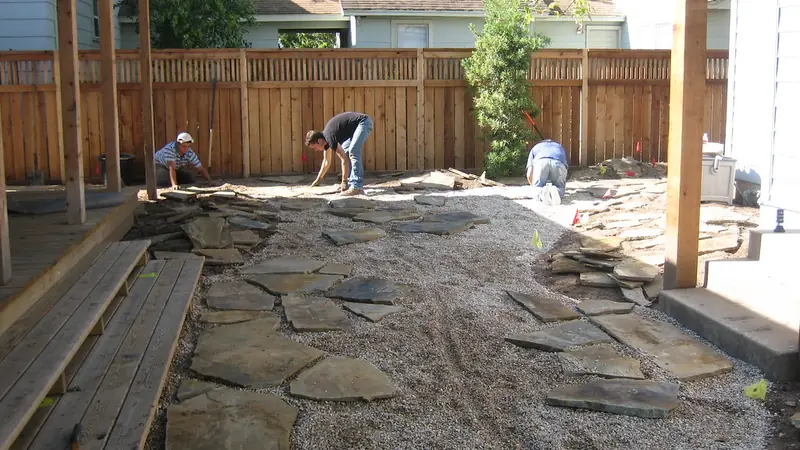
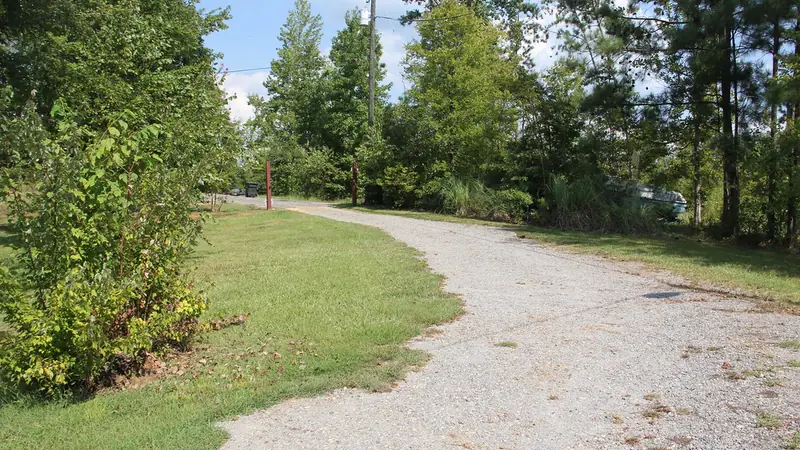
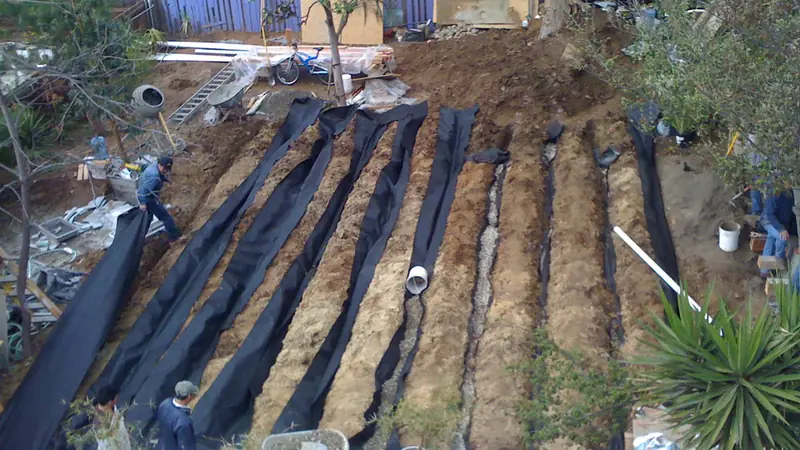
The strongest case for fabric is under gravel on soft ground. The FHWA Gravel Roads Construction & Maintenance Guide describes a woven or non-woven geotextile on the subgrade acting as a separator between weak soil and the new stone: under traffic, fine, wet silt and clay would otherwise pump up into the gravel and leave it “weak, undrainable, and unstable.” The fabric filters out the fine soil while letting water pass through. The same principle applies to gravel paths, patios bases and driveways on soft or clay soil — see how to build a gravel driveway.
Under decorative rock, Utah State University Extension notes fabric is resistant to puncture and tearing and lets water and air reach the soil.
Under mulch in planted beds: think twice
Illinois Extension’s horticulture educator lays out the problems with fabric under mulch:
- It only works for a couple of years. New weed seeds blow in on top, and tenacious weeds grow through.
- It clogs. Fabric is only “somewhat porous,” and over time its pores trap dirt and sediment, making it even less permeable — the educator reports lifting fabric after a soaking rain to find dry soil beneath.
- It traps the mulch. Organic mulch on top decomposes but cannot become part of the soil below.
- It is not permanent. Cheaper fabrics degrade, pulling weeds tears it, and planting annuals leaves it full of holes.
Alternatives in planted beds
Illinois Extension suggests:
- Thicker wood mulch — up to 6 inches on new beds to suppress the first flush of weeds. Coarse wood chips let water and air through better than shredded mulch, which can knit into a crust.
- Newspaper — a couple of sheets, no glossy inserts; it decomposes.
- Plain cardboard, with tape and labels removed and wide holes around plants — it can shed water when dry.
- Not plastic sheeting, which the educator calls “truly the wrong direction.”
Quick decision guide
| Situation | Fabric? |
|---|---|
| Gravel driveway or path on soft or clay soil | Yes — as a separator |
| Decorative rock where nothing is planted | Often useful |
| Planted bed with wood mulch | Usually not — use thicker mulch |
| Beds where you plant annuals each year | No |
Based on FHWA, Utah State University Extension and Illinois Extension guidance.
If you use it: installation tips
- Smooth the ground and remove rocks, stumps and debris first (FHWA).
- Roll it out free of wrinkles and folds, and pin it down quickly, especially in wind (FHWA).
- Overlap joins generously — FHWA uses at least 18 inches under road gravel; follow the fabric maker’s guidance for paths and beds.
- Never drive equipment on bare fabric; dump the stone and push it out over the top (FHWA).
- Cover it completely so sunlight does not degrade it.
Work out rolls, including overlaps, with the Landscape Fabric Calculator or the guide how much landscape fabric do I need.
Sources
- Illinois Extension — The Disadvantages of Landscape Fabric — How landscape fabric performs over time under mulch and rock, and alternatives.
- Utah State University Extension — Using Mulches in Utah Landscapes and Gardens — Organic vs inorganic mulches, recommended depths, material per 1,000 sq ft and landscape fabric.
- FHWA — Gravel Roads Construction & Maintenance Guide (2015) — Cross-section shape, recommended crown, what makes good surface gravel, placing and compacting layers, geotextile separators, potholes and washboarding.
Sources were checked when this guide was published. Where published guidance differs, this guide says so; for structural work, follow your local specification.
Worked examples are generated by the same tested calculation engine as our calculators. See our editorial policy and methodology.