On this page (7 sections)
Every gravel driveway develops potholes, ruts or rippled “washboard” sections sooner or later. Filling holes with fresh stone treats the symptom; they come back after the next rain. The FHWA Gravel Roads Construction & Maintenance Guide — written for road crews, but based on principles that apply to any gravel surface — explains the causes, and the causes point to the fix.
Potholes and ruts: a water problem
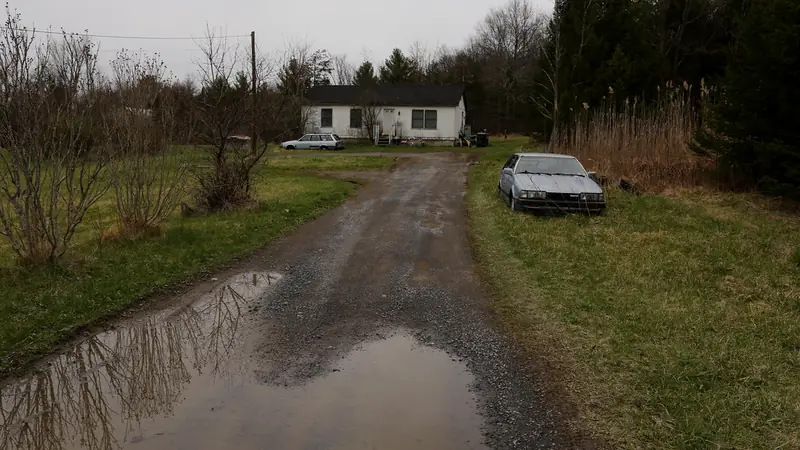
FHWA describes how, without an adequate crown, water collects on the surface during rain or snowmelt and softens the crust; traffic then forms ruts and potholes, and rutting can extend down into the soil beneath. Its photo of a road lacking crown shows potholes and corrugation forming for exactly that reason. A rounded (“parabolic”) crown causes the same trouble in the middle, where the surface is too flat to drain.
The fix is to restore the shape, not just fill the holes:
- Loosen the surface around and below the potholes so you are working with sound, well-mixed gravel rather than patching a hole in a hard crust.
- Reshape the surface to a straight-line crown of about ½ inch per foot (4%) from the edges up to the center — FHWA’s recommendation — and never more than 6%.
- Make sure the edges fall away and water has somewhere to go: a shallow swale, ditch or lower ground. Standing water anywhere in the cross section is one of the main reasons gravel surfaces fail.
- Compact the reshaped surface — with a roller if you can.
If the existing gravel is thin, add surface gravel in a layer at least twice the top stone size (FHWA’s rule of thumb), blend it in and compact. Work out how much with the Gravel Calculator.
Washboarding: four causes
Washboarding (corrugation) is the rippled surface that rattles a car. FHWA lists four primary causes:
- Driving habits. Hard acceleration and braking — at the street entrance, on slopes, around curves.
- Lack of moisture. In dry weather the surface crust loosens and particles “float” into the ripple pattern.
- Poor-quality gravel. Good surface gravel needs fractured stone and fine particles with a binding characteristic.
- Lack of crown. Water collects in the dips, softens them, and traffic makes them deeper.
FHWA notes that virtually any gravel will develop some washboard under traffic and it can never be completely eliminated — but good gravel, good shape and timely reworking keep it under control.
How to fix washboard
- Wait for moisture. In dry conditions you can only smooth the surface temporarily. FHWA advises getting out and reworking washboard areas when moisture is present.
- Cut below the ripples. Loosen the material to a depth of 1 inch or more below the bottom of the depressions, mix it and lay it back to the proper shape — scraping off the tops of the ridges just leaves the same loose material.
- Compact. Rolling (or at least wheel compaction) helps the crust re-form.
- Fix the material. If washboard keeps returning, the gravel itself may be the problem. FHWA suggests adding material with the right blend and binding fines and mixing it thoroughly into the existing surface.
Potholes where gravel meets pavement
Holes form easily at the joint with a paved road or garage slab. FHWA’s approach: taper the crown out gradually so the gravel matches the pavement, cut out and relay severe potholes, and pull any stone that spills onto the pavement back onto the gravel — loose stone on pavement is slippery.
Loose stone on top?
If the surface never firms up, you may have clean base stone or rounded gravel on top. FHWA explains that base material has too little fine material to form a crust, and rounded stone does not lock together. A layer of proper surface gravel — crushed stone with sand and binding fines — is the long-term fix. See how to build a gravel driveway and pea gravel vs crushed stone.
Routine care
- Reshape when you first see ruts or ripples, ideally after rain while the gravel is moist.
- Keep the edges, swales and any culvert under the driveway clear so water can leave.
- Rake stone thrown to the edges back onto the driving surface.
- Convert any top-up you order from cubic yards to tons with the Cubic Yards to Tons Calculator.
Sources
- FHWA — Gravel Roads Construction & Maintenance Guide (2015) — Cross-section shape, recommended crown, what makes good surface gravel, placing and compacting layers, geotextile separators, potholes and washboarding.
Sources were checked when this guide was published. Where published guidance differs, this guide says so; for structural work, follow your local specification.
Worked examples are generated by the same tested calculation engine as our calculators. See our editorial policy and methodology.