On this page (8 sections)
Whether you are checking that a patio sheds water, planning a path up a bank or levelling a lawn, you need to know how steep the ground is. Slope is just the height change divided by the distance — expressed in a few different ways.
Measuring rise and run
- Drive a stake at the high point and one at the low point.
- Tie a string to the high stake at ground level, pull it to the low stake and level it with a line level (or use a laser level).
- The run is the horizontal distance between the stakes along the string.
- The rise is the height of the string above the ground at the low stake.
The formulas
Angle = arctan(Rise ÷ Run)
Ratio = 1 in (Run ÷ Rise)
Inches per foot = Rise (in) ÷ Run (ft)
Slope conversion chart
| Grade | Angle | Ratio | in per ft |
|---|---|---|---|
| 1% | 0.57° | 1 in 100 | 0.12 |
| 2% | 1.15° | 1 in 50 | 0.24 |
| 5% | 2.86° | 1 in 20 | 0.6 |
| 10% | 5.71° | 1 in 10 | 1.2 |
| 25% | 14.04° | 1 in 4 | 3 |
| 50% | 26.57° | 1 in 2 | 6 |
| 100% | 45° | 1 in 1 | 12 |
Exact conversions. Percent and degrees are not proportional: 50% is 26.57°, and 100% is 45°.
Worked example
A patio area falls 3 in over 16 ft.
- Grade = (3 ÷ 12) ÷ 16 × 100 = 1.56%
- That is 0.187 in per ft, 0.9°, or 1 in 64.
How much slope a patio, path, drive or drain needs depends on the surface and your local code or designer; use the numbers above to check what you have against what is specified.
Working backwards: how much drop do I need?
If a plan specifies a grade, rearrange the formula to find the drop to build in:
For example, a 20 ft run at a specified 2% grade needs a drop of 20 × 0.02 = 0.4 ft, which is 4.8 in. Set the string line level at the high end, then mark the low end 4.8 in below it, and grade the base to the string.
Long or uneven runs
- Measure in stages. For a long slope, measure rise and run in shorter steps and add the rises; a string sags over long distances.
- Check several lines. Ground rarely falls evenly. Measure along a few parallel lines and across the area to find low spots where water will collect.
- Keep units consistent. Rise in inches and run in feet is fine for “inches per foot”, but convert to the same unit before calculating a percentage — or let the calculator do it.
Common mistakes
- Measuring the run along the sloping ground instead of level. On gentle slopes the error is small; on steep banks it is not.
- Confusing percent and degrees: a 10% slope is under 6°.
- Reading a ratio backwards: “1 in 20” means 1 unit of rise for every 20 units of run, which is 5%.
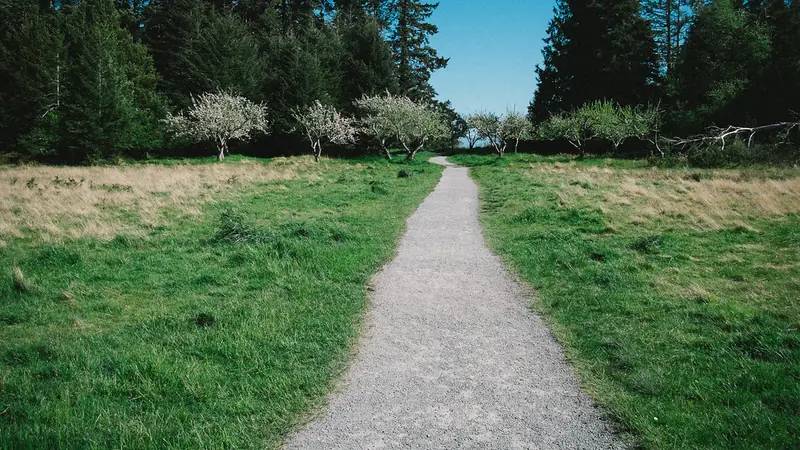
The Slope Calculator converts any rise and run instantly. For paved areas, see the Paver Patio Calculator; for paths, how to plan a gravel garden path.
Sources
- NIST Special Publication 811 — Guide for the Use of the International System of Units (SI) — Exact definitions of the inch, foot, yard, acre, pound, US gallon and the cubic yard used in every calculation in this guide.
Sources were checked when this guide was published. Where published guidance differs, this guide says so; for structural work, follow your local specification.
Worked examples are generated by the same tested calculation engine as our calculators. See our editorial policy and methodology.